The physiological and psychological benefits of sound, music and community
Main story for my senior journalism capstone. Published Dec 12, 2025.
The nervous system
When I have a panic attack, my lungs tighten and I can’t breathe. My whole body becomes numb, all I can do is gasp for air. My brain is sending signals to my body that it is in danger, even if it’s just overwhelming stress. This feeling can leave me paralyzed, tricking my brain into thinking there is no way to stop it.
However, I have learned one thing that can get me out of it, I play the song “Breathe” by Pink Floyd.
The majority of the song bounces between an E minor and A7 chord, mimicking a 4-count breathing pattern. As I listen, I can hear the song inhaling and the exhaling. I allow my lungs to follow the pattern, filling and deflating. I slowly feel the tingliness lighten, bringing feeling back into my body, allowing my brain to find stability in my environment.
The human nervous system is the controller of communication with the outside world as well as the structural functions within the body, tying together the mind and body. In this scenario, the body is experiencing a shift from the sympathetic nervous system, or “fight or flight,” toward the parasympathetic nervous system, which allows your body to “rest and digest.”
Robin Craig is an organic intelligence faculty member and meditation teacher with a background in clinical psychology. Organic Intelligence (OI) is a non-directive, positive reinforcement framework that emphasizes growing and healing from trauma and addiction. Craig said practices like this can help support nervous system regulation, creating a healthy mind-body connection.
Craig has noticed more disconnection with the increase of technology. Mindless actions like receiving likes on Instagram or scrolling on Tik Tok release dopamine, which, if unregulated, can lead to addiction patterns. A feedback loop is created, encouraging more use.
I am very familiar with this feeling as an avid social media user, and I can only imagine some of the other 2 billion users on the app can agree. I find myself scrolling, frozen in one spot with my thumb stuck to the screen. It brings me guilt, a sense that I am not doing what I should be. But after one more scroll I am either crying or laughing, the dopamine pulls me back in and the loop starts again.
“It’s like this feeling of anxiety and fear that we get that puts us in that fight or flight mode. It’s like it can be so impossible to break out up to the point where you don’t even realize it’s happening,” Craig said. “You just are convinced that that’s kind of the way it works … We believe our physiology when it’s in those states, part of that is safety.”
The Vagus Nerve is the main controller of the parasympathetic nervous system and runs from the brain, down the sides of the neck to the large intestine. These specific nerves control the body’s ability to switch back and forth from “fight or flight” to “rest and digest.” When someone is in a static position, for example scrolling on their phone, the vagus nerves are not being stimulated. Putting the phone down and looking around the room, stretching your neck to take everything in, can immediately activate those nerves, allowing the body to slip back to a regulated state.
A paradox exists with technology connecting us more with others while also disconnecting us from the physical world. Craig said that when someone holds up a phone to capture a moment, they are placing something directly between them and the world.
Watching a Tik Tok of a soldier coming home may allow for an emotional reaction, but it is significantly less authentic than experiencing it in real life around other people. This system encourages isolation and exploitation of real human moments, pulling people away from actually enjoying the life that’s in front of them, not the one on the screen.
“If we’re in it with each other, we know sometimes [disconnection] stings a little … I can just notice that, it doesn’t have to be a big deal,” Craig said. “If I’m not used to that, I’m just used to the phone connection … it’s almost like my tenderness is too raw for interpersonal connections.”
On a daily basis, one in five Americans are reported to be lonely. With an ever expansive digital world, this problem is more prevalent than ever.
The Harvard Study of Adult Development has studied the lives of hundreds of Americans since 1938 and has concluded that “loneliness kills.” Their research shows that isolation and unhappiness can be as deadly as smoking or alcoholism, with faster overall health decline and a shorter life span. In addition, good relationships with family, friends and community are protective, keeping people happy and healthy.
Craig acknowledged the power of community to regulate the nervous system as well as things like meditation, Somatic Experiencing, nature retreats and music therapy as well as engaging in religion and spirituality.
Somatic Experiencing (SE) is a body-oriented therapeutic model that focuses on how trauma impacts the nervous system. The practice brings awareness to the sensoric responses that happen in regards to the body and brain, encouraging mindfulness to shift toward the parasympathetic nervous system.
One way SE encourages this is by increasing awareness of sight, smell, touch, taste and sound.
Sound Healing
Sound has many different applications in this lens. Jan Michael Mead is a spiritual practitioner in Flagstaff and has experienced first hand how powerful sound can be.
Mead first experienced the power of sound at the Firefly Gatherings, a festival he created with his friends to bring together art, music, healing, community and bliss. Mead created a healing arts temple for the event.
“One person brought in one crystal bowl once and asked if they could play it. Just by that one bowl, I witnessed the response of the people who were at the festival,” Mead said. “It did what I was hoping for with everything else … The sound is what did it.”
Mead believes strongly in the combination of art and spirituality, which has guided his practices of healing arts. He lives by Sanatana Dharma, or “eternal truth,” a Hindu way of life he has seen manifest into sound.
“The energetic field that is around us is real; the heart emits electromagnetic waves that extend far beyond itself, those are intercommunicating with everything,” Mead said. “Sound just seems to clarify that.”
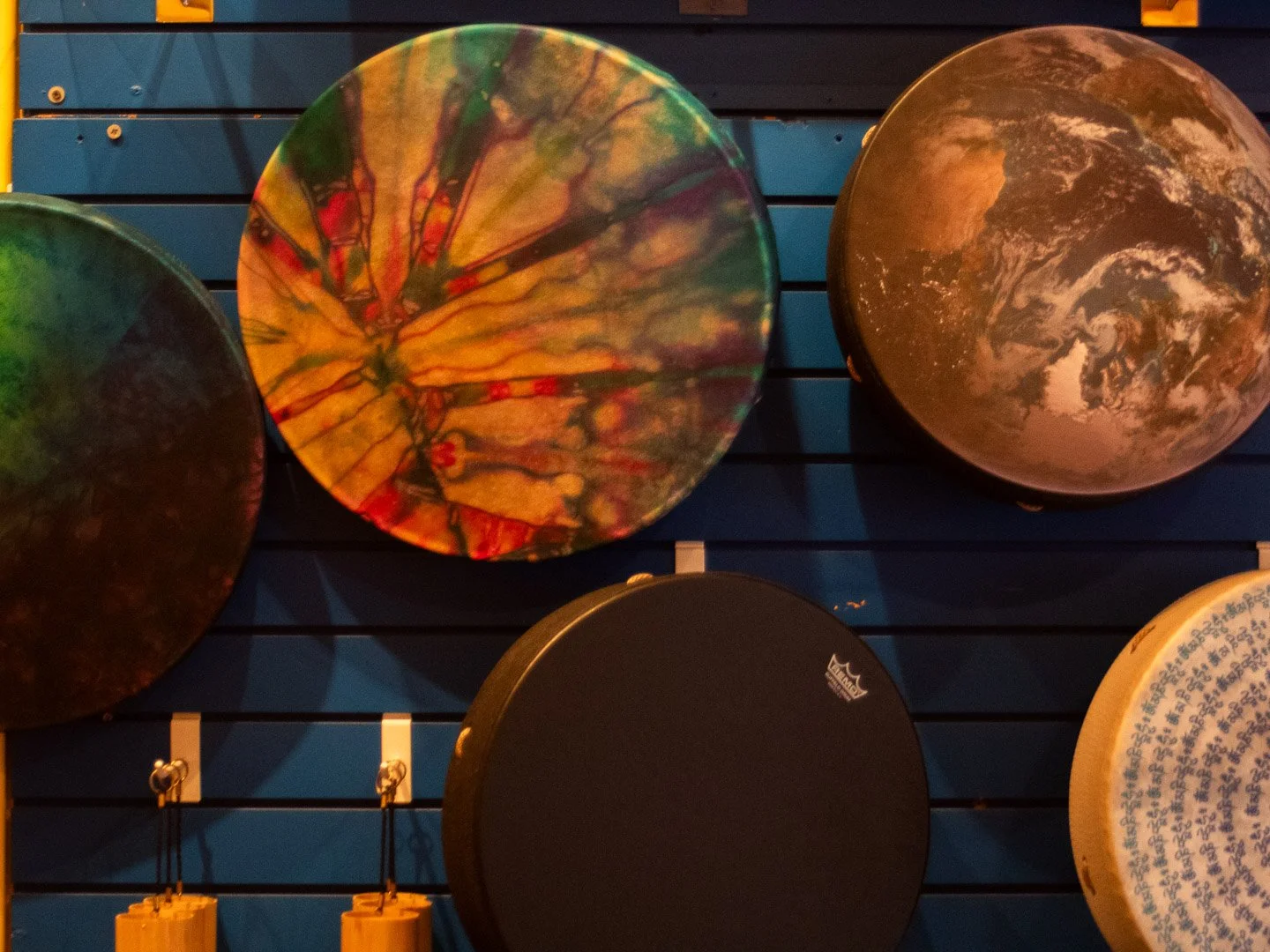
Mead poured himself into the pursuit of spiritual sound healing after seeing what it could do for people. He brought his art to groups in his office, at Firefly Gatherings and around town, and it took off from there. He since has held a “ritual reset” at Northern Arizona Yoga Center and works at Sacred Rites, a store in Flagstaff that sells sound healing instruments like drums, hand pans and singing bowls.
Mead explains the connection to sound in ways research never could, stating that “sound is divinity.” He said sound can be a vehicle to connecting and communicating with the divine, however that may be interpreted.
“Simply by playing a bowl, a gong, a drum, it invites people into this space that’s already there,” Mead said. “[It’s] profoundly energetic, profoundly spacious, devotional interconnectedness.”
Skeptics may be quick to judge spiritual aspects of this practice if they do not align with what they know. However, research shows that sound healing allows the nervous system to shift to the parasympathetic mode, improving things like focus, mood, sleep and stress.
Mead said he knows and understands the science behind it, but rather than explaining it to someone when they’re browsing in Sacred Rites, he walks them over to the monochord chair.
A monochord chair is a handcrafted instrument used for full body healing. With a harp-like instrument built into the back of the chair, the experiencer is able to feel the vibrations deep within their body.
“I’ve played for hundreds, perhaps thousands of people in the sound therapy chairs, and people often come back and express their long term benefits of even just five minutes of sitting in them,” Mead said. “I never asked a thing, I didn’t know anything. I’m not a healer; I’m an artist, and these sound waves do the healing.”
Mead’s own connection to the divinity of sound came from an experience at a live show for the band Sound Tribe Sector 9. “I was at their show, and I closed my eyes, and it was in front of me, the Orb was in front of me.”
Mead said he knows this can be a very conceptual feeling and can be hard to understand if you haven’t experienced it, “but when those things are happening, they’re real, and they’re showing us that our lives are not just what we think they are,” Mead said. “It was the most ecstatic experience I’ve ever had; music absolutely can do that.”
Mead said this practice is ancient but takes different forms in every aspect of life, influencing secular spirituality. The holistic ideas of sound healing apply to everything, even the songs someone puts on a playlist.
“Every human being is affected by sound,” Mead said. “It’s in religion. It’s outside of religion. It’s in popular music. It’s in the person playing a song to only his cat. It’s literally everywhere, and we can all stimulate it at any moment.”
Mead shared what he essentially believes is the purpose of life, which is to improve ourselves, evolve and grow as an individual and with our surroundings while also enjoying it.
Healing with music
It can be a lot of hard work to find a “purpose” in life, but every step toward an authentic life is a step toward finding it. Human creation has given way to tools to help on that journey, one of the biggest ones being art and music.
Jake Ferraro, NAU student and local musician, sees music as a modern medium of philosophy.
“The focal point of [music] is just really expressing yourself and being who you really want to be,” Ferraro said. “Music is probably the greatest way to do that, whether it’s from your unconscious or conscious mind.”
As a songwriter, Ferraro said this can manifest into his own songs. He uses his lyrics to analyze questions about the human experience he is looking to explore.
It can be easy to see how the artist asking the questions and writing down the words is directly connecting to the experience. However, Ferraro said this experience can happen as a music listener as well. Artists like Bob Dylan or Lou Reed have encouraged him to think, inspiring him to do the same for his listeners.
Joe Keery, or stage name Djo, is an artist using his platform to pose questions to himself and the world, which has resonated with me greatly. His second studio album, “Decide,” perfectly depicts many different aspects of the human experience, with room for individual interpretation. Songs like “Gloom” and “Figure You Out” make the deep corners of my consciousness feel seen and songs like “On and On” and “Half Life” break me out of the mindless habits I find myself falling into.
As a listener, connecting with a song’s lyrics can create a sense of validation. Although there is no verbal or direct communication, that connection exists. Keery is a successful actor and musician, but he still questions himself the same way everyone else does.
When someone compliments my Djo shirt that I got at the concert, it could very well be small talk. But a part of that interaction indicates that they felt moved by the music, and are looking to connect with someone else who feels the same way.
Sierra Bryan is an independent musician who has seen her love of music to shape the connections in her life. She grew up involved in church and found that the worship music community grew her as an individual.
“I think having a space to reflect is important,” Bryan said. “While in a religious setting, prayer is one of those, but I think music and singing and listening to words is also a form of that as well.”
Worship music is praise, prayer and proclamation, with themes from the bible such as grace, freedom, acceptance and holiness. Many themes that are seen throughout all genres of music, religious or not.
“This moment where we’re all singing together [in worship] feels holy,” Bryan said. “Even though I look at religion and spirituality in a different way, I still feel that going to a concert, playing a show or seeing my friends on stage play beautifully. It gives me chills.”
Bryan said that an important part of her religious experience was the community and support that it created. Mentors and peers encouraged her to take leading roles in worship groups and to write, record and perform her music.
From there Bryan found creating music to be therapeutic, exploring her own thoughts and struggles and sharing them.
“These heavy things that are hard to bring up in day to day life, I’ve gotten to share in a vulnerable way, but also as a performance,” Bryan said. “It’s been like another way that I’ve been able to find community with strangers or friends or people.”
Fans and peers have come up to Bryan after her shows expressing that they “all of a sudden didn’t feel so alone.” She said connecting in these ways is what keeps her driven.
“These people you have nothing in common with other than this one thing, whether that one thing is we both believe in God and we practice in this way, or we both like this band and so we’re going to this show,” Bryan said. “There’s something magic that happens when a bunch of people are together and they’re in celebration.”